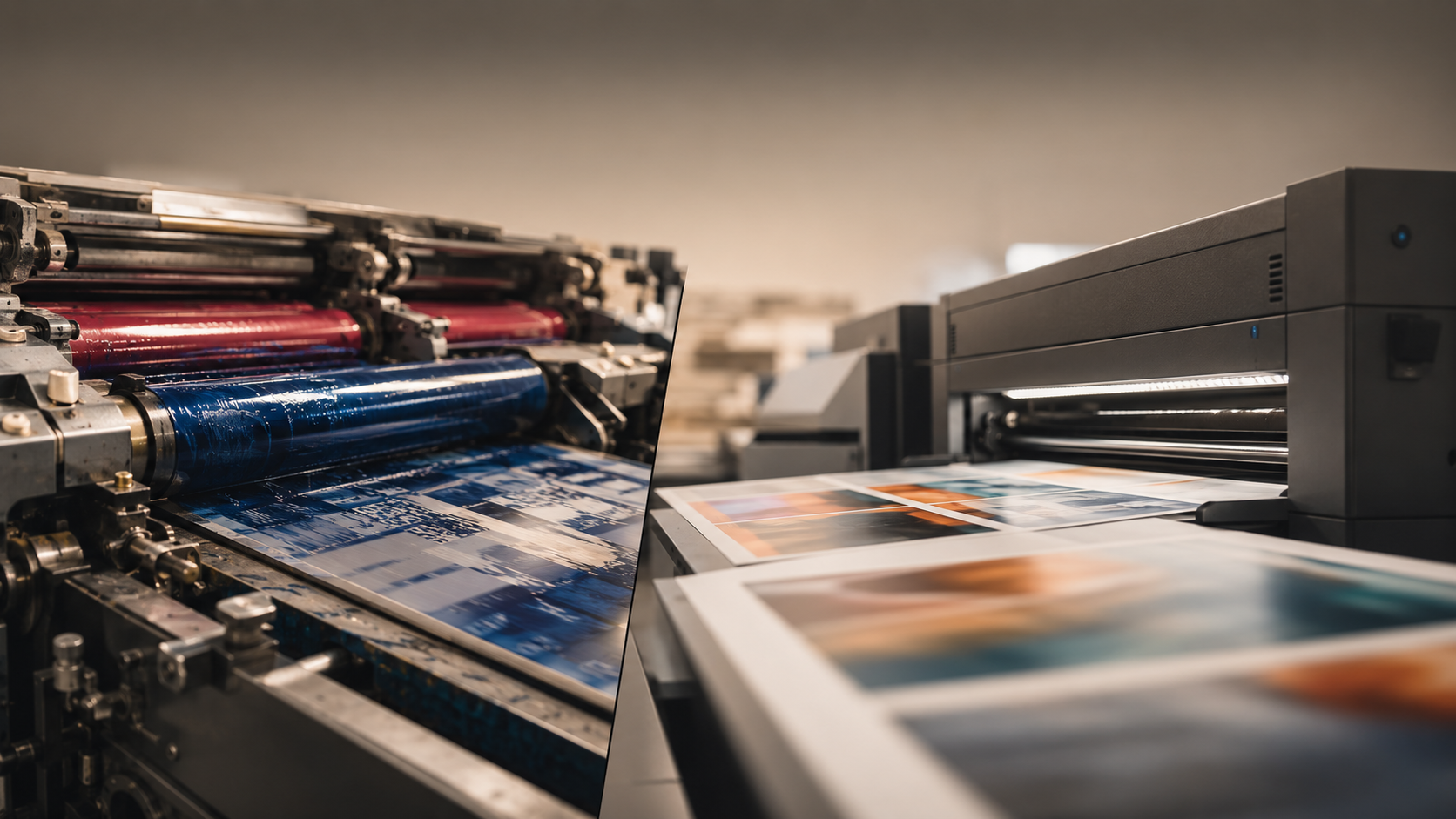
Offset and digital printing can produce visually similar results on a proof, but they behave very differently once cost, run size and turnaround are factored in. Choosing between them isn't about which process is better, but about which one matches the size and shape of the order in front of you.
Understand how each process actually works
Offset printing transfers ink from a plate to a rubber blanket and then onto the print substrate, using a separate plate for each colour. This makes plate setup the main upfront cost, but once running, offset presses print very quickly and consistently at large volumes.
Digital printing applies ink or toner directly to the substrate without plates, using the same digital file for every sheet. This removes the setup cost entirely, but each individual sheet costs more to print than an offset sheet does once a press is running at scale.
- Offset uses printing plates and ink transfer; setup cost is upfront and fixed.
- Digital prints directly from file with no plates, so there's no fixed setup cost.
- Offset becomes cheaper per unit as volume increases.
- Digital stays a flat cost per unit regardless of quantity.
Let run size decide the process, not preference
For large runs, typically several thousand units or more, offset is almost always the more economical choice, since the plate cost gets spread across enough units that the per-piece price drops well below digital. This makes offset the default for established products with predictable, high-volume reorders.
For smaller runs, samples, or one-off orders, digital is usually cheaper overall, since there's no plate cost to spread and the per-unit price stays flat whether printing ten pieces or a few hundred. The crossover point varies by job, but it's worth asking for pricing at both processes when the order sits in an ambiguous middle range.
- Use offset for large, high-volume runs where plate cost is spread thin.
- Use digital for small runs, samples or one-off orders.
- Ask for pricing under both processes when the quantity is in the middle range.
- Reorders of an established design often favour offset once volume is proven.
Factor in turnaround time, not just cost
Digital printing generally has a faster turnaround since there's no plate-making step before the press can run, which makes it a better fit for urgent orders or last-minute reprints. This speed advantage can matter more than the per-unit cost difference when a deadline is tight.
Offset requires more lead time upfront for plate production and press setup, so it's better suited to orders planned well in advance. Rushing an offset job to match a short deadline usually adds cost without meaningfully improving the timeline compared to switching the order to digital instead.
- Digital printing has little to no plate setup time, making it faster for urgent jobs.
- Offset requires plate production lead time, so it suits planned, non-urgent orders.
- Consider switching to digital rather than rushing an offset job under a tight deadline.
- Confirm turnaround time alongside cost when comparing quotes for both processes.
Compare colour accuracy and consistency needs
Offset printing generally holds colour more consistently across a very large run, since the plates and ink mix stay fixed for the entire job, and it can use exact spot colours (like Pantone matches) that digital sometimes approximates rather than reproduces precisely. This matters for brands with strict colour standards across large volumes.
Digital printing has improved significantly in colour accuracy, and for most packaging jobs the difference isn't visible to an end customer, but it's worth requesting a printed sample rather than a screen proof when exact brand colour matching is critical, regardless of which process is used.
- Offset holds exact spot colours more precisely across very large runs.
- Digital colour accuracy is strong for most jobs but may vary slightly from screen proofs.
- Request a printed sample, not just a screen proof, when brand colour matching is critical.
- Flag any strict Pantone or brand colour requirements before choosing a process.
Plan for variable data or personalisation separately
Digital printing supports variable data printing, meaning each piece in a run can carry different text or imagery, such as a recipient name or a unique code, without slowing down the press. This makes it the only practical choice when personalisation is part of the order.
Offset printing cannot vary content piece to piece within a single run, since every sheet is printed from the same fixed plate. If a job needs both a large core run and a personalised element, it's common to print the bulk piece offset and handle the variable detail as a separate digitally printed tag, sticker or insert.
- Use digital printing when any personalisation or variable data is required.
- Offset cannot vary content within a single print run.
- Split large runs into an offset core piece plus a digitally printed personalised element.
- Confirm personalisation needs before quoting, since it changes the process outright.
Common questions
At what quantity does offset printing become cheaper than digital?
The crossover point varies by job, but offset generally becomes more economical once a run reaches roughly a few thousand units, since the plate setup cost is spread across more pieces. It's worth requesting quotes for both processes near this range.
Which printing process is faster for urgent orders?
Digital printing is usually faster for urgent jobs, since it skips the plate-making step required for offset and can start running as soon as the file is ready.
Can digital printing match exact Pantone brand colours?
Digital printing has improved significantly, but offset generally holds exact spot colours more precisely across large runs. A printed sample should be requested whenever exact colour matching matters.