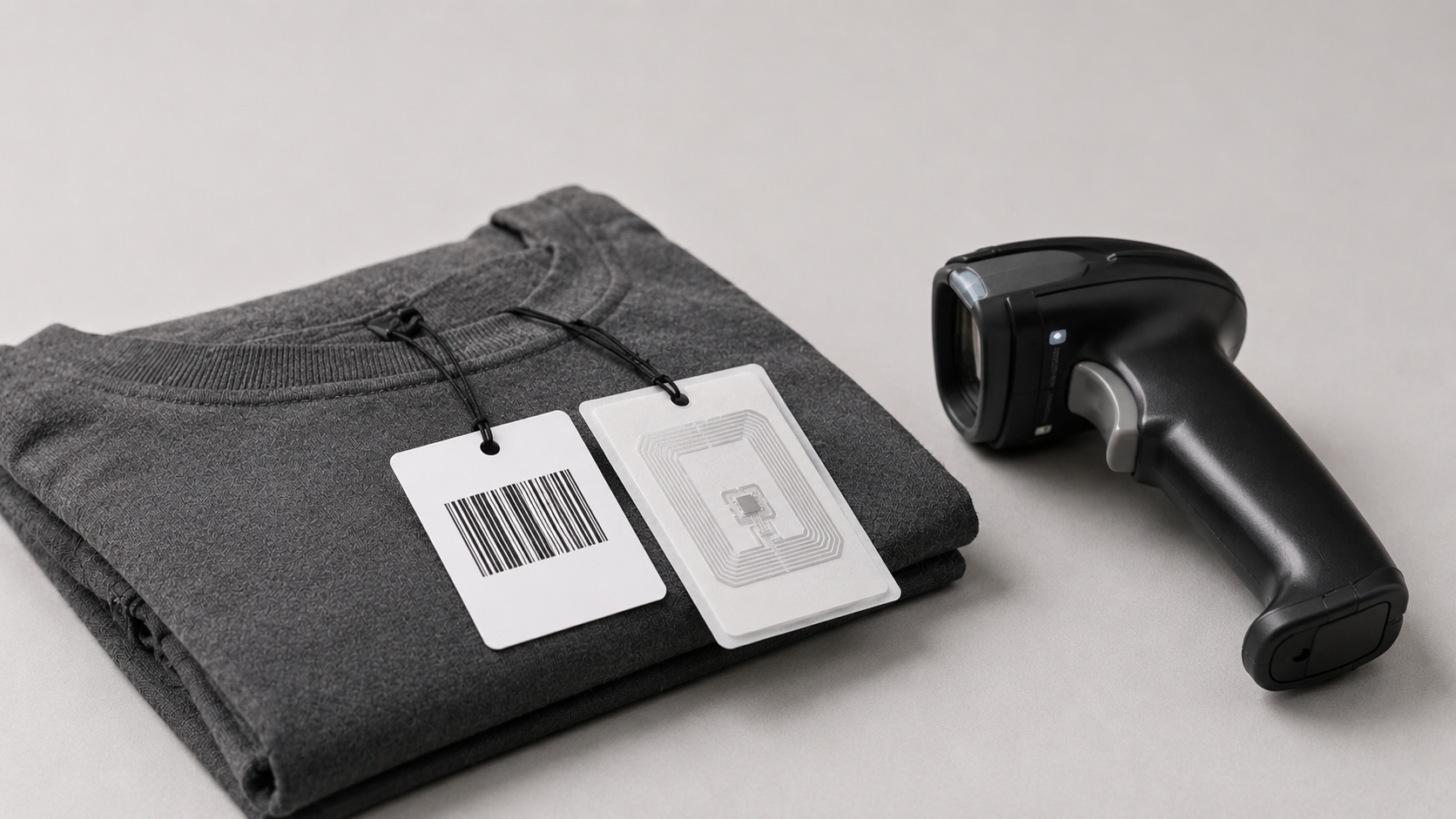
Barcodes and RFID solve the same basic problem, identifying a product, but they do it in fundamentally different ways that lead to very different cost structures and operational benefits. Deciding between them, or when to layer RFID on top of an existing barcode system, comes down to where inventory accuracy and labour cost actually matter most in the business.
Compare the fundamental scanning difference
Barcodes require a direct line of sight and individual scanning, meaning each item generally needs to be picked up, or at least positioned so the barcode faces the scanner, one at a time. This makes barcode scanning inherently sequential, regardless of how fast an individual scan itself is.
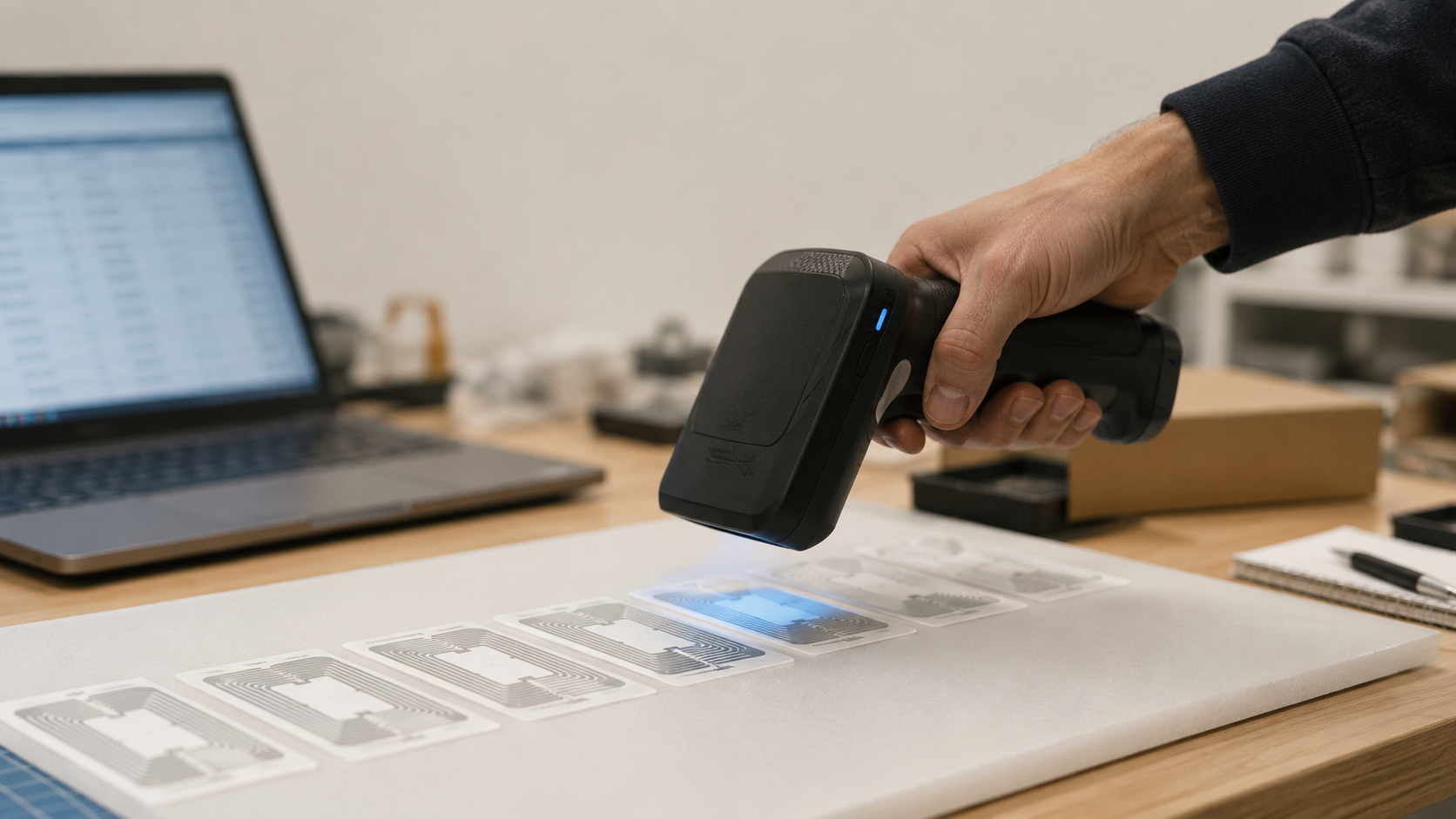
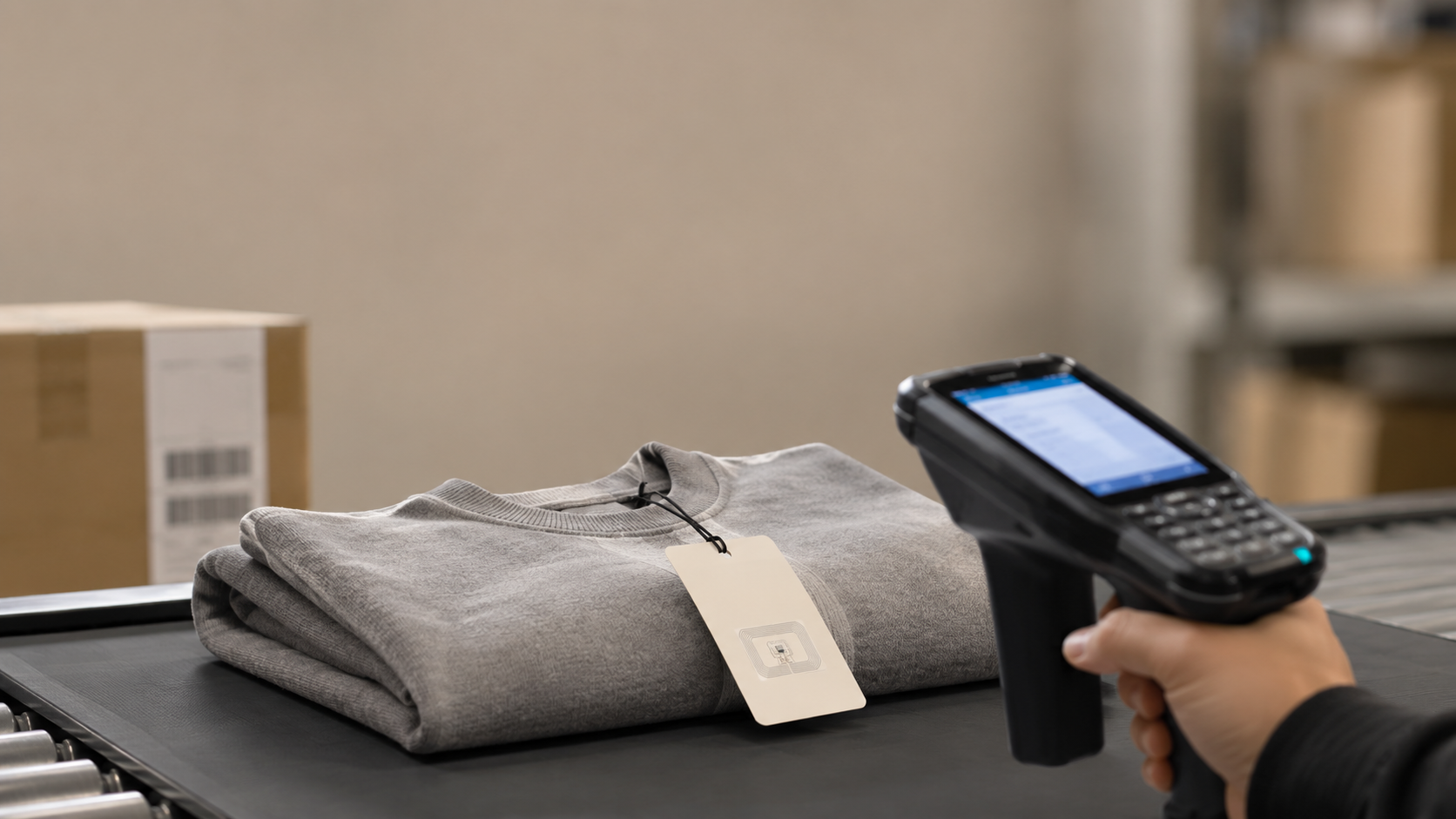
RFID tags can be read without line of sight and without individual handling, since the reader picks up the tag's radio signal rather than needing to see a printed pattern. This allows an entire box, shelf or rack of tagged items to be scanned in one pass, which is the core operational advantage RFID offers over barcode.
- Barcodes require line of sight and generally sequential, item-by-item scanning.
- RFID reads via radio signal and doesn't require line of sight or individual handling.
- RFID allows bulk scanning of many items in a single pass.
- This bulk-read capability is the primary operational advantage RFID has over barcode.
Compare per-unit cost honestly
Barcode labels are significantly cheaper per unit than RFID tags, since they require only basic printed material and no embedded electronics. For low-margin, high-volume products, this cost difference can be a meaningful factor in overall packaging or labelling cost.
RFID tags cost more per unit due to the embedded chip and antenna, and this gap, while narrowing over time as RFID production scales, still needs to be weighed against the labour and accuracy benefits RFID provides, rather than assumed to be justified automatically.
- Barcode labels are cheaper per unit than RFID tags due to simpler construction.
- RFID tag cost includes the embedded chip and antenna, raising per-unit price.
- Weigh the per-unit cost gap against expected labour and accuracy savings.
- Reassess the cost gap periodically, since RFID tag pricing continues to shift with scale.
Compare labour cost and speed at scale
Barcode-based inventory counts require staff to individually scan items, which takes considerably longer for large stock counts, cycle counts, or receiving large shipments, since each item needs direct handling and scanning. This labour time is a recurring, ongoing cost rather than a one-time expense.
RFID substantially reduces this labour time, since a bulk scan can count an entire rack or shipment in a fraction of the time a barcode count would take. For businesses with frequent, large-volume stock counts, this labour saving is often where the strongest RFID ROI case comes from, more so than the tag cost itself.
- Barcode counts require individual item handling, adding recurring labour time.
- RFID bulk scanning significantly reduces labour time for large stock counts.
- The strongest RFID ROI case often comes from labour savings, not tag cost alone.
- Estimate current labour hours spent on stock counts before building an RFID business case.
Compare inventory accuracy improvements
Barcode-based inventory relies on every scan being completed correctly and consistently, and manual scanning is prone to missed items, mis-scans or gaps during busy periods, which compounds into inventory records that drift from actual stock over time.
RFID's bulk-read capability tends to produce more consistently accurate counts, since there's less reliance on a person individually locating and scanning every single item correctly. Retailers commonly report meaningfully higher inventory accuracy after RFID adoption compared with barcode-only systems, though the exact improvement depends on rollout quality and reader coverage.
- Barcode accuracy depends heavily on consistent, correct manual scanning.
- RFID's bulk-read approach reduces reliance on individual scanning accuracy.
- Inventory accuracy improvements after RFID adoption are commonly reported but vary by rollout quality.
- Measure current inventory accuracy before rollout to have a clear baseline for comparison.
Decide where a hybrid approach makes sense
Many retailers keep barcodes on all products as a universal, low-cost baseline, and layer RFID on top for specific high-value, high-shrinkage, or high-SKU-complexity categories where the accuracy and labour benefits most clearly outweigh the added tag cost, such as apparel or electronics.
This hybrid approach avoids the cost of tagging an entire product range with RFID before the ROI case is proven, while still capturing the benefit in the categories where it matters most. It's generally a more practical starting point than an all-or-nothing decision across the full catalogue.
- Keep barcodes as a universal, low-cost baseline across the full product range.
- Layer RFID onto high-value, high-shrinkage or high-SKU-complexity categories first.
- Avoid an all-or-nothing RFID rollout before the ROI case is proven in a specific category.
- Reassess which categories justify RFID as tag costs and rollout experience evolve.
Common questions
Is RFID always better than barcode for retail inventory?
Not automatically. RFID offers real advantages in scanning speed and accuracy at scale, but the higher per-unit tag cost needs to be weighed against actual labour and accuracy savings for the specific product category.
Where does RFID typically deliver the strongest ROI?
The strongest ROI case usually comes from labour savings during large stock counts and improved inventory accuracy, particularly in categories with high SKU complexity like apparel, rather than from the tag cost alone.
Can a business use both barcode and RFID together?
Yes. A common hybrid approach keeps barcodes as a low-cost baseline across the full range and adds RFID only to specific high-value or high-shrinkage categories where the added cost is most clearly justified.